Showing posts with label film. Show all posts

Tuesday, 18 October 2011

Donny Recommends: Lecture screening - "Page One: Inside the New York Times"


Who would have known while we are aspiring to become a journalist, we can also indulge ourselves into being a little bit of a film critic? For this week's lecture, the whole lecture room has moved to the Schonell Theatre, where we are very honoured to participate in a premiere screening of "Page One: Inside the New York Times", a fascinating documentary about several issues in journalism.

While we are watching it, I couldn't help but think of how many issues exactly that the film has covered. I believe there are almost 10 of them, covering in a variety of topics like media reporting, plagiarism, the current media landscape, blog-like journalism, being a foreign correspondent in the war-torn Middle East, bad outcome of evil news business, and many things that surrounds the history of the New York Times.

In the film, we get to understand how they write news, personally I found it not surprising, but breathtaking that they have to write almost 5000 words for a featured topic; how they have meetings on what to put on the front page, and looked at how pessimistic other people working on alternative media see the traditional, and declining newspaper industry.

We also followed David Carr, who was a cocaine addict but turned journalist in the New York Times, his interviews are sublime and outstanding, and most of the time, funny because of his cheeky personality. His prominent role in the film helps me understand his role as a journalist is very important on informing and uncovering truths behind the shades, in this case, the scandals surrounding the ex-CEO of Tribune Company, Randy Michaels (NYT feature by David Carr), about his misconducts towards colleagues and sexism across the newspapers under the company.

This film is a must-watch, and since I'm not a professional movie critic I'm very good at writing details and opinions about this film, but I wholeheartedly recommend this movie for everyone, especially people who are interested about the news industry, because you'll never know anything about it until you've seen it.


D.

Monday, 22 August 2011

Donny Recommends: The Island (2005)

Time to have a movie recommendation for my readers. For me I don't really like to see those holiday movies where everything was either 'BAM!', 'WOOSH!' or 'SPLAT!'. It doesn't serve any purpose for me, and I sometimes even find it revolting just to watch with my friends where they were simply watching it for the explosions and actions. Well, not for me. I paid tremendous attention to the plot and the meaning behind films so that makes me usually watch it either with one or two friends, or even alone. Sad? Not really, I'm just enjoying the time spent with myself.
Poster of The Island
Enough with the crap, let me introduce this movie The Island. The Island is a science fiction movie about an apparently futuristic compound with people living in it. The people there were told that the outside world was contaminated and therefore they have to follow a very strict regulations in there, from daily diet to social relationships in order to regulate the population and breed.

However the protagonist of the film, Lincoln Six Echo, did not feel competent with the situation he is in, plus more evidence that made him know probably the world outside was different from what they were told to be. So he investigates.
Lincoln Six Echo (Ewan McGregor) and Jordan Two Delta (Scarlett Johansson)

One of the main subplot of this film was the Island lottery, where everyone will have a chance to win and escape from the isolated compound. People in there were really anticipating that one day it will be one of them to win the prize. However, behind this so-called lucky draw, it was actually a myth, and Lincoln found out the people inhabited in the compound were actually clones of real people of the 'outside' world, where wealthy people sponsored to clone their body and once ever they have body parts malfunctioning, they can harvest the clone's body and no one will know it. And the lucky draw's use was exactly for that.

As Lincoln found out more and more about this immoral doing of this company which told the sponsors and the government the cloned parts were do not gain consciousness, so he escaped with Jordan Two Delta, a friend who has just won the lottery and try to find their sponsors.

Cloned human fed with fake memories
This movie is really reflecting about the ethics of cloning and it gives me an interesting view on what if this really happens in the future where body parts are simply genetically grown and be transplant into dying people's body. It's a sad to see so many people are being killed just to replace body parts and yet they never know that the so-called lottery was the final destination of their lives where they are being harvested. One scene, where a pregnant woman has won the lottery as she started to labour, and as Lincoln followed the medical staff that escorted her into the surgery room, he found out after she gave birth to a baby, she was instantly injected with toxins and killed in the spot, where the baby was given to a wealthy family. That was really screwed up.

So, I do recommend this film to everyone who wants to have a special perspective about human and their cruelty, not to mention that selfishness and the contrastive morals towards the other kinds of people.


D.

Tuesday, 9 August 2011

Focus: Lecture - Telling factual stories with pictures (Week 3)

I am a a big fan of photography, and I own a DSLR which I truly adore. I've learnt a lot about pictures and video editing in my past studies at TAFE, now that in today's class, Bruce has introduced us to the world of pictures in journalism.

The most immediate thing I found is, pictures are everywhere and basically they penetrates your magazines with all those glossy page of advertisements. Pictures, are around us. But how could something we take for granted will be as a part of journalism? Well, basically, the function of a picture is to document a moment or an object. No matter it is being used as billboards or news clip, they have the same purpose.

And throughout history from cave carvings to stained glasses in churches, they are all being used to learn about something, to be observed through our eyes. Since the advent of photography, more of these kind of pictures are blooming, especially for newspaper where in the past they were in plain text, and thanks to the invention of camera, they no longer needed to paint drawings themselves. They will get the picture with just a snap.

Powerful pictures can blew people's mind, like the famous Afghan Girl from Steve McCurry:

Afghan Girl


No one exactly knows when should he/she take a picture in the right moment, and this really depends on either that person's experience, and most of all, luck. If something doesn't happen at all, you won't even have a chance to take that picture.

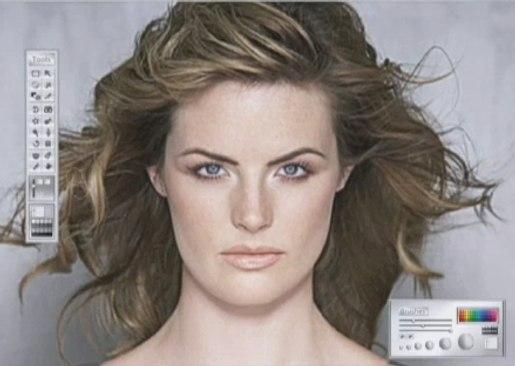
In the 90s, as technology grows and develop as fast as a bullet train, there is photo-manipulation, edits. Sometimes these images has such an impact to the audience. But sometimes they distort our perspective to certain matters, one of them is self-esteem.

Bruce gave us an example of how ridiculous can a girl put on make-up, had her photo taken, put it into Photoshop, and turned out into a completely "optimised" and modified version of the girl.
From this...


To this...
It was an awe-inspiring lesson. Beside my past knowledge about photography, I think I've picked up a few tips from Bruce and hopefully I will be able to apply it to my photographic skills in the near future!


D.